The deployment of health equity across regional and sub-regional governance systems: a scoping review of the extent, range and nature.
Authors: Uchechukwu Ngwaba, Aeda Salim, Jasmeen Bassi
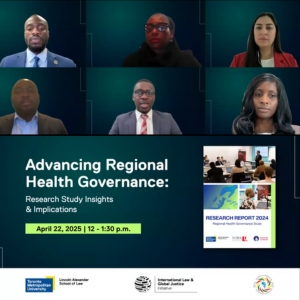
This scoping review project examines how equity has been articulated, institutionalized and operationalized within regional and subregional health governance arrangements globally between 2005 and 2025. Against the backdrop of the COVID-19 pandemic—which exposed profound failures in global solidarity, inequitable access to vaccines and health products, and the limitations of the WHO-led global health governance system—the project responds to growing recognition that regional systems may offer more context-responsive and equity-driven approaches to managing transnational health threats. The project is grounded in concerns that, despite repeated invocations of equity in global health discourse, there has been little systematic assessment of whether equity principles have meaningfully shaped regional health governance practices during this period. The study employs a PRISMA-guided scoping review to answer two core research questions: whether equity has been deployed in regional and subregional health governance, and the extent, range and nature of that deployment. Through a synthesis of academic literature and policy documents, the scoping review systematically maps how equity has been defined, institutionalized, and operationalized within governance instruments, mandates and practices across regions. A third research question, to be addressed through a focus-group workshop, examines Canada’s role in advancing equitable access to vaccines and health products domestically, regionally, and internationally, with particular attention to the Inter-American system. The focus-group workshop explores how Canada contributes to norm formation, regional cooperation, and equitable pandemic management, positioning regional governance as a critical intermediary between global health responses and national health actions.